Category Archives: Projects

USATODAY.com – Into the Pixel

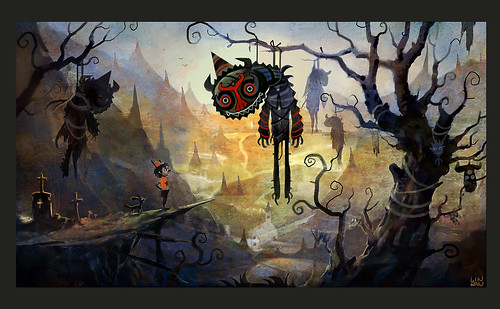
Spicy Horse conceptual artist Lin Ran did a series of images during early “Grimm” pre-production. I posted some of these images to my flickr account a while back, like this one, “The Boy Who Went Forth to Learn What Fear Was”:

The Boy Who Went Forth to Learn What Fear Was

These images were entered into the annual “Into the Pixel” competition – “An exhibition of the best video game art at E3.” – and “The Boy” won! Congratulations to Lin Ran on this prestigious honor.

USA Today is running an article on the event and a nice gallery:

Across town from E3 at the LA Convention center’s “E for All,” the Into the Pixel exhibition examines the most stunning art from last year’s games. A jury of museum curators, designers and producers selected sixteen pieces from submissions worldwide based on the “criteria of traditional fine art,” according to Lead Juror Kevin Salatino.

Check it out here:

USATODAY.com – Into the Pixel

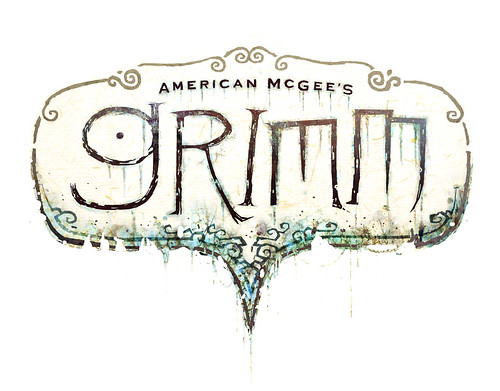
The “Grimm” Logo

Behold it in all its glory:

Grimm Logo

The process for choosing a logo can be weird and painful. There’s conflicting opinions on the value of a product’s logo and packaging in general. Would “World of Warcraft” be any less successful if it shipped in a brown paper bag with “WoW” scribbled in crayon on the outside? Would Apple’s brand perception be what it is if its logo was anything more than simple Macintosh with a bite taken out of it? And who decides what’s best – art director, test audience, marketing guy?

While trying to decide what to do for the “Grimm” logo we had two prevailing (and conflicting) thoughts on direction. Option 1: Simplicity, ala a non-illustrated movie “logo” (basically a simple font treatment). OR Option 2: illustrated logo that “said something” about the product. No amount of argument could make these two camps see eye to eye. So we decided to put it to a vote.

Fifty logos were put on display and votes were taken. Ironically, the sample audience avoided both the overly simple and overly illustrated logo samples. They went for the logo you see, something I feel is “in the middle”.

I’ve always been a firm believer in the idea that “a horse designed by committee is a mule.” So maybe our logo is a mule, but I like it. It’s simple and it says something about the product.

(“Grimm” logo designed by our art director, Ken Wong.)

American McGee

No one loves a good ‘ol American McGee interview more than American McGee. Or so I thought until I did an interview with the guys over at ShackNews. Chris Faylor and his readers really enjoy their American McGee. Case in point:

Every morning, American McGee’s American McGee arises from the American McGee’s bed and slips on his American McGee slippers. After performing ablutions in a traditional twisted manner, he enjoys American McGee Coffee in his American McGee cup. Then after sorting his American McGee mail, he American McGee’s to the American McGee for some solid American McGee with American McGee. American McGee, American McGee, American McGee.

Whew! That’s almost too much of me. Or so I thought until I read a new interview with American McGee … er, me … this morning.

Shack: Thanks for taking the time out of your hectic schedule for us, American.

American McGee: Thanks Chris Faylor! American McGee is happy to participate in American McGee’s interview. Interviews give American McGee a chance to talk about American McGee’s projects, American McGee’s ideas, and American McGee’s American McGee. American McGee

Ok, Ok… even I’m starting to get tired of myself now. But, if you think you can handle more then head over and check out the article. During the interview Chris and I discuss cool things like “Grimm”, bad things like “Bad Day LA”, and what would happen if I made a game with Sid Meier.

And regarding all this nonsense about my name, as I’ve said many times before – none of “me” would exist were it not for the talented people I’m surrounded by. Pictured below are a few of those people – the core team of Spicy Horse in Shanghai. From left to right are: Yeng Jin Hui (Technical Director), Zhang Lie (Programmer), Zhao Xhu (Level Designer), Ludo Piraud (Level Designer), Wim Coveliers (Producer), me, Nancy Tang (Office Manager), Yuan Shao Feng (Concept Artist), Ken Wong (Art Director), Ben Kerstlake (Concept Artist), Tang Ye Ping (Animation Director), and Jiang Sheng (Technical Artist). The Spicy Horse team in Shanghai. From left to right are: Yeng Jin Hui (Technical Director), Zhang Lie (Programmer), Zhao Xhu (Level Designer), Ludo Piraud (Level Designer), Wim Coveliers (Producer), American McGee (Creative Director), Nancy Tang (Office Manager), Yuan Shao Feng (Concept Artist), Ken Wong (Art Director), Ben Kerstlake (Concept Artist), Tang Ye Ping (Animation Director), and Jiang Sheng (Technical Artist). Not pictured: Adam Lang (CTO), Marwin So (Game Designer), and Tomasz Dzierza (Level Designer), RJ Berg (US Executive Producer), Dawn Ellis-Lopez (US Community Manager).
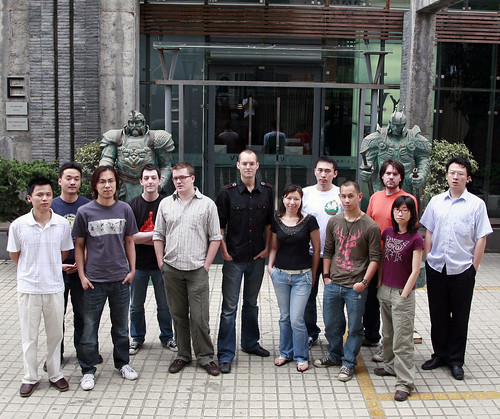
Spicy Horse Team

Mainstream Download

AP News is featuring an article discussing the (re-)emergence of mainstream downloadable game content. Mention is made of GameTap and the Grimm project.

GRIMM FUTURE: If you want a really enormous library of classic games, however, you need to turn on your PC and head over to GameTap. The online service owned by Turner Broadcasting System has more than 850 titles, 30 of which are free to play even if you don’t pay the subscription fee.

However, GameTap’s biggest success over the past year has come from its commitment to episodic games — namely, the six-episode run of Telltale Games'”Sam & Max.” GameTap’s next episodic project is even more ambitious: “American McGee’s Grimm” is a 24-chapter game scheduled to launch in the first half of 2008. It’s an action-adventure game based on the Grimm brothers’ fairy tales, from Rapunzel and Rumpelstiltskin to Snow White and Little Red Riding Hood.

I find this whole “downloadable games is the wave of the future” topic slightly amusing given the fact that so much of the games industry was built on the success of digital distribution in its 1st era – 15 years ago.

During my time at id Software I witnessed firsthand the power of online distribution. At one point a guy from the University of Wisconsin contacted us to tell us exactly how our games were impacting the school. When a new id game demo was released this guy could see bandwidth usage go up dramatically. And he’d charted an opposite graph – student test scores, which dropped significantly in the weeks after a demo or game release.

Something I often wonder: Why did publishers move away from online distribution of all their PC products? Why the 10+ year hiatus, which for most publishers continues? Was it internet bandwidth vs. product size? Addiction to “box product”? Love of revenue generation (never mind profit)? Consolidation of market (the monopolistic sort)? Well, whatever the reasons – I for one am happy to see the trend reversing.

Danger – I Made This!

An interview on Gamasutra today posed some interesting questions, including:

American McGee On Creative Outsourcing
GS: What do you think “American McGee Presents:” in front of a game title means in the minds of gamers?

AM: That depends on the gamer. I’ve seen positive and negative responses. For the “fans,” I think they have come to expect something a little different from the mainstream. That’s my hope anyway. For the detractors, I get the sense they feel I haven’t earned the name-above-the-title right.

Soon after the article posted I received this comment to my blog:

I used to believe you putting your name on your products was just a reflection of your pompous, narcissistic nature, but now I realize after playing your latest “butt mud” that it was a bit of a warning sign. American McGee on a title now has the same effect to me as the Surgeon General’s warning on a pack of cigarettes. “DANGER: AMERICAN MCGEE MADE THIS” Just wanted to say thank you again.

Blahahaha. Awesome. This guy gets it!

When looked at from this perspective you’d think the haters would have reason to rejoice at my name being in the title. They never have to worry about accidentally playing a demo or buying a game that I’ve been involved with.

I wonder if he’d mind my borrowing his idea. From now on games I’m involved with could be called something like:

“DANGER: AMERICAN MCGEE MADE THIS – Twisted Fairy Tale #6”
or
“DANGER: AMERICAN MCGEE MADE THIS – Other Person’s Idea #4”
or

Well… you get the idea. And the best part is that all these bored, irritated detractors could go off and lead safe, happy lives. Only if they become addicted to, or affected by second-hand usage of my games would they have reason for their anger and grief. Like a cigarette smoker who inhales despite the warnings, then sues someone when he gets cancer.

But then, what would they have to vent their unfocused rage upon? Maybe at that point they’d start using their time and energy to write letters about things that matter, like genocide victims in the Sudan, the false “war on terror”, or hell, something more “selfish” like their rights as American citizens being taken away in the name of “protecting freedom”.

Nah, what’s the point in that when you can slam on a silly, budget video game that you haven’t even bought a copy of!?

It’s All Around You – Animated Short

A great little animation highlighting the ridiculous nature of fear. Thanks to Jacob for the link:

It’s All Around You – Animated Short
An original animated short created specifically for the Final Destination 3: Thrill Ride Edition DVD.

This sort of thinking is what Bad Day LA is based on. The idea that people worry about the big, highly unlikely forms of death more than they should. They allow the fear of terrorist threats, bio-chemical attacks, bird flu, and other media-spread “dangers” to control their lives. People trade their freedoms in exchange for “safety” from what are basically non-threats.

On a recent trip to China one of my expat friends commented to me on the fact that the Chinese government and media work in the exact opposite fashion. If there’s a chemical plant explosion, a plane crash, or a hi-jacked school bus, the media will down-play or even hide the event. The Chinese government forcefully discourages the dissemination of information that would cause panic or “civil unrest” among its population of 1.5 billion.

I guess because the Chinese government already has absolute control they no longer feel the need to rule by fear. Their primary goal now is to maintain stability and peace. For the US, I suppose that’s good news: As soon as the US government is as controlling as the Chinese government, they too will stop using fear as a tool on their own people.