Look Ma! No Hands!

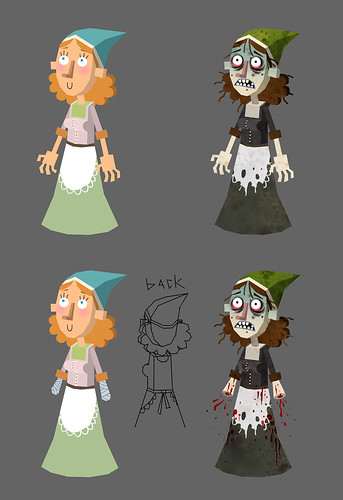
This character comes from one of the more gruesome tales we’re dealing with. As you can see she’s been “given the chop” – rendering her handless:

Girl No Hands

Since my days at id Software I’ve been a fan of  blood, gore, lava, and guts. Back then we used to revel in “gibs”, laugh when imps were exploded into meaty showers of goo, and thrill to the screams of space marines bathing in lava. With “Grimm” I’m excited to once again be dealing in a fiction where blood fountains and rivers of lava are prevalent.

More Christmas Fun

Christmas Holiday in China isn’t that big a deal. Mostly the Chinese use it as a ploy to push more stuff at retail. Then again, that’s what it’s become in most parts of the world. The Chinese just aren’t as good at masking the underlying capitalistic nature of the holiday. But give them a few years, I’m sure they’ll learn. On a positive note, the holiday is kept mercifully short.

And so, we’re already back at work!  And I have more concept artwork for you:

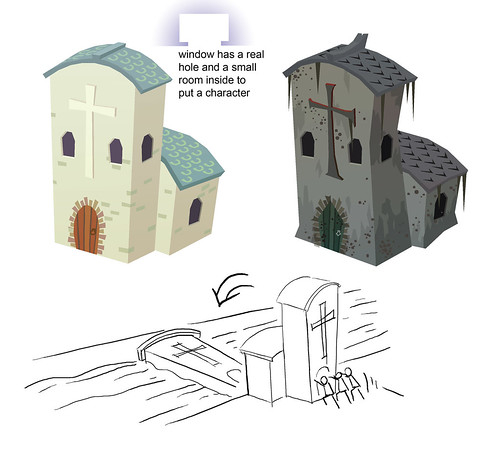
Nunnery

This is a nunnery from  an episode I’m not allowed to name. (Aren’t rules awesome?) In this image you see the before and after of a building which becomes a bridge. The in-game cinematic shows the building being pushed into a river of lava by nuns who are converted into winged demons. Nothing says Christmas like demonic nuns and lava!

Merry Coconut-mas

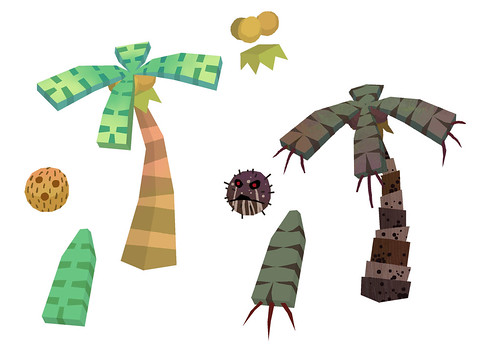
Seems I forgot to post a new image yesterday. Things around the office have been hectic. Pushing towards a milestone and preparing for a little Christmas break. In China there’s not usually time off for Xmas – but since we’re an American owned company we feel compelled to honor the St. Nick holiday. In honor of the holiday, a festive tree:

CoconutTree

Not too traditional,  but fun anyway. Hope everyone out there has a good one. Happy Holidays!

Grimm Buildings – DynoBait

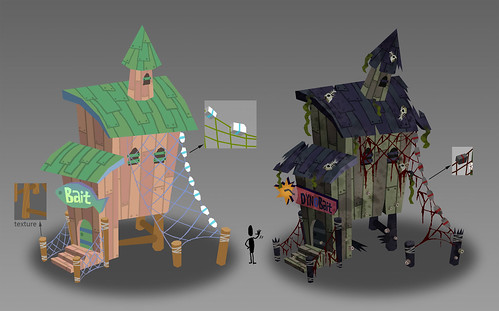
So far all the Grimm concept images I’ve posted have focused on characters. But as I’ve mentioned before, everything in the game is built in twos – light and dark: Characters, vehicles, props, and buildings. Here you see an example of a building from the game.

BaitShop

This structure is taken from the episode based on “The Fisherman and His Wife”. It’s featured in the scenes where the Fisherman returns to the Magic Fish to ask for greater and greater wealth/power for his wife.

This is an episode that is currently in the Concept->Alpha phase. During this time an individual level designer will spend 6 weeks building the basic terrain, locking semi-tuned game play, placing all the major narrative scenes, and inserting 90% of the final art assets/sounds/particles/etc.

Burnt Blacksmith

Today I’m working on the script and “scene listing” for a Grimm episode based on “The Boy Who Went Forth to Learn What Fear Was”. So I thought I’d post a bit of artwork related to that episode. Here you see the light/dark version of a blacksmith worker from the opening scene of the episode. These guys get theirs when the happy metalworks they’re laboring in turns into something straight out of Mordor.
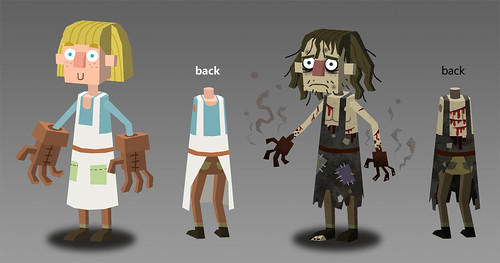
Burnt Smith Worker

Internally, we refer to this episode as “BoyFear”. Other lengthy tale names also get shortened, “Cinder”, “NoHands”, “FishWife”, and “DevilHairs” being some fine examples.

For each episode we tackle there’s a tremendous amount of documentation generated. Adapted narrative drives episode design documents, VO scripts,  cinematic scene scripts, asset lists (NPCs, objects, terrain textures, sky boxes, particles, sound effects, etc), task lists, programming requests, AI updates, schedules, MS Project files, and so forth. We treat each new episode as a virtual stand-alone project, and separate creative, production, and tracking information as such.

Episodic production certainly has its interesting differences from traditional single-box-product development. One of these days, when I find time, I’ll get into some more detail on the differences.
Headless Bunny

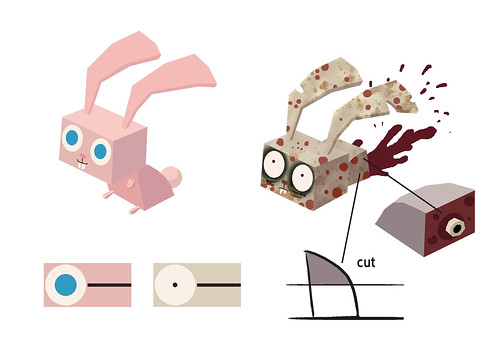
One key rule we’ve learned while building assets for Grimm is to push for more interesting transformations. People playing the game tell us “greater contrast between light and dark = more interesting.” Early on, “light/dark” was communicated with distinctly different textures, but somewhat similar geometry. These days we’re trying to build assets that reflect equal changes in geometry… and in behavior. This rabbit is a good example:

Headless Rabbit

When this guy is converted, not only does his texture change, but his geometry as well. AND with a character like this you’ll see his behavior change – from a hopping movement to a jet-powered rocketing movement.

Take that silly rabbit!