We’re going to be tweaking the theme here in a bit, and it may take a little while. Please refrain from fussing about broken links or weird spacing until we’re all done.
Actually… refrain from doing it then, too. 😉
We’re going to be tweaking the theme here in a bit, and it may take a little while. Please refrain from fussing about broken links or weird spacing until we’re all done.
Actually… refrain from doing it then, too. 😉
Lots of news these days about Lenovo’s announcement of the “Ebox” – a game console built in and for China (as well as the rest of Asia). It’s not the first time a Chinese console has been attempted – Shanda’s own homegrown console (EZ Station) of years past had similar aspirations towards the Chinese console market. Where Shanda stumbled hard on a variety of marketing, hardware and software issues – one hopes Lenovo’s experience in device manufacturing can see them through to a retail product.
But the real challenge isn’t going to be the hardware, games or interface (though those things need to be right) – it’s going to be penetrating a market which is already saturated in terms of digital content portals. China is, by in large, an online country. Games, TV, music, movies, shopping, eating – everything is faster and easier online. How do you supplant (or just supplement) an existing digital pipeline that’s functioning well enough to turn companies like Tencent into “juggernauts“?
Here are couple of things I think they’ll have to get right if they’re going to have a chance:
1. Make it online only.
2. Build an iTunes-like store interface (easy to navigate, uncluttered).
3. Enforce platform-wide interface and quality guidelines.
4. Enable quick, easy payments for purchases (link into existing payment 5. channels used in Internet Cafes).
6. Cross market titles on and off platform (with Tencent, for example).
7. Sell it for a loss and make the profits in software.
8. Don’t make it “too Chinese” (Chinese consumers love foreign brands).
9. Attract license content which already does well in China (Transformers, World of Warcraft, Hello Kitty).
10. Partner with big brands looking to fund advertainment (Coke, Nike, Audi, etc).
Further (and probably most importantly), successfully attracting an initial market will require killer apps. Without developers to create highly creative and attractive game offerings, the platform will go nowhere. And if China’s lacking one thing – it’s a large number of developers experienced in the creation of AAA console content. Never mind the global lack of experience in creating content for motion control enabled systems like Kinect – we’re all trying to find our footing there.
Personally, I wish them all the luck in the world. It’d be great to see the miraculous growth of the Chinese gaming market bolstered by a quality console offering with the requisite offering of great games. If we’re lucky, the entry of a Chinese made contender will eventually serve to open the market to an influx of foreign made consoles and games.
A few notes in the margins… There’s a lot of confusion in Western press about restrictions on gaming and gaming consoles in China. For a primer filled with useful facts, I highly recommend reading through China gaming legal expert Greg Pilarowski’s China Video Game Industry Legal Primer (July 2010)
An excerpt from the primer reads:
In many jurisdictions, including the United States and Europe, the video game market is dominated by console games. In mainland China, however, game consoles are prohibited. In addition, video game software for use with game consoles or PCs are subject to very high piracy rates. As a result, China’s video game market is primarily an online game market, with revenues from this segment not only constituting nearly all of video game revenues, but also representing a leading internet application in the market by revenue. In June 2000, the State Council issued the Notice on Launching a Campaign against Video Arcades, which prohibits the manufacture and sale of both coin operated arcade game machines and television console game machines.
Although the stated purpose of the notice was to strike against video arcades in order to protect the youth and ensure public order, the notice was drafted broadly and is now the primary legal barrier to the importation, manufacture or sale of game consoles such as the Xbox, PlayStation and Wii.
Notwithstanding the prohibition on game consoles, there is a substantial black market for their sale in China.
And finally – many industry articles seem to take pleasure in labeling the Ebox a “copy” of the Kinect while neglecting to mention (as they once did) that Move and Kinect are themselves reactionary moves (copies) of the successful paradigm shift initiated by the Wii.
 GamePro is going all-out and featuring our very own Alice on the cover of their September 2010 issue. Â According to the article on their website, Will Herring will be discussing the early previews of the game during his 14-page feature. Â Will visited with us in China recently to get the scoop straight from the Horse’s mouth.
In addition to the overview of Alice: Madness Returns, Will also delved into the complex world of tracking the evolution and permutations of the intellectual property of Lewis Carroll’s slightly-addled heroine from the original stories penned in 1865 on through the movie treatment at the hands of Tim Burton.
For us, it’s excellent to be able to talk about the game finally, and even better to listen to everyone else talking about it, too. Â If you missed the original announcement this past Tuesday, EA released the first teaser – and we’re all in agreement that it does tease! Â If there was any question about it’s impending rating, we’re hoping that clears it up.
Get ready to snatch up your copy at the end of July.
Today at the EA Showcase, American finally got to announce the name of the new game, Alice: Madness Returns, and also to show a spectacular 30-second teaser.
EA has now opened up the official Alice sequel website, plus there’s a Twitter account, thewhiterabbit you can follow, and we also now have a Facebook page.
How many more ways could we possibly get you the information as we start giving out more? With the embargo lifted, expect much, much more as we draw closer to some of the most exciting tidbits, like… a solid release date.
… but not yet.
Soon. SOON!
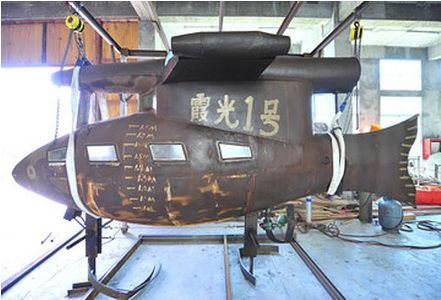
Chinese Farmer Built Submarine
From ArtObserved:
On May 4, the exhibition titled “Peasant da Vincis†curated by the renowned American-Chinese artist Cai Guo-Qiang opened in Shanghai. “Peasant da Vincis,†featuring a combination of inventions by Chinese peasants and works by the artist that explore the subject of human creativity. It is also the inaugural show for Rockbund Art Museum, the first contemporary art museum in the historic riverfront area of Shanghai, known as the Bund.
Read the full article on ArtObserved.
Over the weekend I visited the new Rockbund Museum to see “Peasant Da Vincis” – a exhibit featuring an array of awesome hand-made inventions created by peasant/farmers from around China. I’d previously read with great interest of home-built inventions like the walking, talking rickshaw-pulling robot, fully functional submarine, homemade airplane and helicopter – but I never thought I’d get a chance to see them up close… much less RIDE ON THEM!
The exhibit allows direct interaction with some of the devices – you can actually ride the robot rickshaw. Other inventions like submarines and airplanes are on display inside an open-air atrium filled with birds. The ingenuity and creativity exhibited in the design, construction and function of these devices is truly inspiring.
If you’re interested in checking it out visit the Rockbund Museum website for more details.
EAVB_DGLOPWCAMS
From Shanghai Daily: Wind power to blow strongly
CHINA is expected to increase its total offshore wind-power capacity from 5,000 megawatts in 2015 to 30,000MW by 2020, a senior official at a hydropower institute said.
“Shanghai as well as Jiangsu, Zhejiang, Shandong and Fujian provinces have already submitted their offshore wind-power blueprints. Their combined off-shore wind power capacity could reach 22,800 megawatts by 2020,” said Wang Minghao, vice president of Hydropower Planning Research Institute, who spoke at the Offshore Wind China Conference yesterday.
Read more on Shanghai Daily.
Every time I read a story like this about energy in China it gives me a little bit of hope. While the world reels from oil-related catastrophes (see Gulf of Mexico, Nigeria, Singapore) China continues to push aggressively towards meaningful renewable energy goals:
China is aggressively expanding its renewable energy consumption to reduce reliance on polluting fuels like coal and oil, and plans to increase the proportion of renewable energy to 15 percent of the country’s overall energy mix.
That, combined with Chinese consumer/manufacture awareness of energy efficiency and resource scarcity, means China could become a beacon for sustainability – that is if they aren’t pushed to consume the world first.