Category Archives: General

Video Games can Save the World

Many Worlds

Many Worlds

Dean Takahashi has reported on a contest being run at Linden Lab (makers of Second Life), “We can argue about whether virtual worlds are a waste of time or great entertainment. But the folks at Linden Lab, which runs Second Life, clearly believe that virtual worlds can improve our lives in the real world. The company announced today that it’s holding a contest where it will pay $10,000 to whoever creates a project in Second Life that most improves daily life beyond the virtual world.”

The idea that games could be used to improve life in the real world is of great interest to me. Primarily because I think the real world is in very real danger. Over population, air/water/food pollution, dwindling resources, global warming, and the “last hours of ancient sunlight” are ever increasing threats combining to ensure that life as we now know it on planet earth is an unsustainable concept. It’s not that some thing (singular) has to change. Everything we understand to define “modern life” must change.

The question is: Can you give up all your modern day entitlements? If that guy can drive a Hummer, why can’t you? If that girl can jet off to Lisbon, why not you? He can have a 5000sq/ft house in which he lives alone! Where’s yours?! Without that watch/bag/car/house/dog/TV/travel/etc/etc YOUR LIFE IS UNFULFILLED AND INCOMPLETE!! Ahg! What to do!?!?

Our problem is marketing and advertising. From the moment we’re born we’re told we’re “not enough” without the latest and greatest . All fine and good until the “me, mine, more” culture runs headlong into a few billion too many “me”. There simply isn’t enough stuff in this world to make all the other stuff in this world that we’re constantly being reminded we must have in order to be complete.

I heard not long ago that at present consumption and growth rates, in order to sustain China’s booming economy and development, we would need another planet in about 50 years. Does that frighten you? It should. China is just one of several 1 billion+ person nations currently transforming from 3rd world to 2nd or 1st world.

As Maryann Bird sums it up in this article from “Share the World’s Resources”:
In short, we need to think and debate – as individuals and as communities — about how to achieve more with less, wherever we live. In the developed world, do we really need to fly so much? Do we need a car, or multiple cars? (And how should vehicles be powered?) Do we need more than one house, or to use so much household energy and water? Do we need bottled water, and its plastic bottles? What about our lifetime worth of electronic gadgets and appliances (dramatically represented by artist Paul Bonomini’s “WEEE Man”, now a permanent part of Britain’s Eden Project)? Do we need more furniture, more clothes, more food and flowers flown to us from thousands of kilometres away? Should we have large families, adding to the consuming, demanding masses?

She makes a point, but do YOU honestly think everyone on the planet is suddenly going to stop wanting more? Sure, a few of us are getting on board. We live conservatively, ride bikes to work, and recycle what we can. But we all know – it isn’t enough. For every person who’s discovering they can live with less, there are hundreds who are struggling to “make it” just so they can have MORE.

And this brings me to my point: The world is doomed unless we can give those who want more exactly that. The trick is to do it in a way that satisfies their needs without further taxing our limited world resources. And that’s where we need another world. More to the point, many “other worlds” – game worlds!

Thankfully, we don’t have to wait for NASA to figure out how to get us to Mars and terraform the planet. Games are already taking us there, and other fantastic places. Second Life and other online worlds like it offer the chance to have that 2nd or 3rd house, be transported to that far-away (both geographically and temporally) places, and attain all the wealth, power, and booty one could ever wish for.

To see what’s happening here in China gives me some hope that games might actually save the day. Here, few have the options afforded those in the West. They long ago realized that struggling to attain riches, fame, and power in the real world was in itself unrealistic. There are simply too many other people competing for too few resources. Think about it this way: There’s 1 girl for every 1.2 guys in China. Talk about limited resources.

What to do? Go online of course! All over China people spend their days inside “wang ba” (Internet Cafes), chatting online, socializing, and playing MMOs. They escape from the hopeless reality outside into the world online. Many of them monetize their time by gold farming and other virtual means. And guess what? It works!

Game makers have been perfecting the concept of “Virtual Worlds” for decades now. Soon, the virtual world will be all but indistinguishable from the real thing. In some respects it will be better – and in a very important respect it will be hugely superior: When you build, market, or buy something in the virtual world you’re buying bits and bytes. The impact on real world resources is insignificant.

So, if you ask me, game technology can save the world. And those parts of the world that most need it – the places where development is outstripping resources – it’s already happening.

If I were to enter the above-mentioned contest, I’d submit the following:

A universal avatar/ID assigned at birth and used throughout life for all interactions online. This would link into an all-encompassing Uber-Portal that connects together all past, present, and future online experiences. Some day I’d hope to “walk” from my office, into “Universe of Warcraft”, then into the “iTunes VR Store”, all on my stroll “home”. When finished, I’d unplug my implant/take off my goggles, and already be at my real home. As would everyone else.

We have the tech, we have the need, what’s required now are the connections and the spaces.

Michael Crichton Died

From The LA Times: Author Michael Crichton has died at age 66 after “a private battle with cancer.” Crichton’s career was probably one of a kind: After training as a doctor at Harvard and working as a fellow at the Jonas Salk Institute, he became a bestselling author, then a successful screenwriter, award-winning movie director and TV producer. The movie “Jurassic Park,” based on his book and on which he shared screenwriting credit, is the No. 10 top grossing film of all time. I spent some time working with Crichton – enough to gain immense respect for his intellect, creativity, and the way he lived his life. If you’ve never known him beyond his books and films, I suggest you read his autobiography, Travels.

Traffic Bump

Traffic Bump

Traffic Bump

Last week we tried something new: Pitching a game concept in a public forum, via my blog. The motivation was simple: Reach as many potential publishers and end-users as possible without having to leave my office in Shanghai. I wasn’t sure what to expect in terms of reaction, but I have to say any expectation I had was blown away by the tremendous amount of press coverage, flickr visitors, YouTube watchers, and user comments generated.

Spicy Horse is now talking with 30 different publishers worldwide about the BaiJiu Racer concept. And user feedback on the art style and concept has been extremely positive. Seems that pitching a game concept via the net might actually work. The next big hurdle will be to secure an actual publishing deal. Of course what comes next is generally kept private until an official announcement is made. So while I’m all for the new-style method of pitching games, I’ll keep the remaining process traditional – and confidential. When I have public news to announce, you’ll be the first to know.

In the meantime, we’ve got more Grimm on the way this week. Halloween is just around the corner, Grimm’s a dark little guy, and wouldn’t you know it, the two go together like steak and knives. This week’s upcoming episode is a visit to the famous tale of “The Master Thief” and is chock full of vampires and zombies, scares and frights.

What’s that you say? There were no vampires or zombies in the original “Master Thief”? Huh, someone better tell Grimm and quick!

BaiJiu Racer Concept Announcement

Widescreen BaiJiu Race

Bai Jiu Racing

Today we’re going to try something a little different: Pitching a video game concept!

Traditionally when I’ve pitched game concepts the process involved face-to-face meetings with potential publishers, use of our agents (CAA) back in Los Angeles, and lots of traveling. Well, I’m getting old, China is FAR from the rest of the world, and the Internet can do a lot of amazing things, so here’s a game pitch for the next generation:

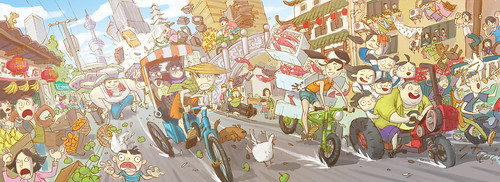
Announcing “BaiJiu Racer” – An MMO-lite racing game concept with China as the core theme. The concept has been in focused pre-production for the past three months here at Spicy Horse. Working with our Chinese publishing partner ICEE we’ve crafted a solid Game Design Document, Technical Design Document, Art Bible, Visual Target Demo, and Development Plan. Together these materials constitute a compelling pitch for a title we think will be a strong competitor in the worldwide, lite-MMO, online racing category (think “Kart Racer”).

A lot of teams dream of a “Mario Cart” or “KartRider” killer – and we think our concept goes a long ways towards being a viable contender. For one, it’s the first Chinese cart racing game developed with an authentic and original Chinese art style, set in real-world locations, and featuring some of the funkiest racing vehicle designs the world has ever seen (inspiration coming from actual Chinese vehicles). We’re focusing on semi-realistic (and fun) physics-based racing dynamic, going light on the power-ups, and throwing in a lot of visual action. Check out the art and video to see the result.

A few key features and differentiators:
* Distinctive art style featuring a timeless portrayal of everyday Chinese people and locations
* A clean and clear graphic style for UI
* Core gameplay focused on skill-based racing, avoiding fun-killing power-ups
* Strong narrative backbone and emotional drama – “everyone can be a hero”
* Unique and interesting vehicle designs based on real-life Chinese vehicles
* Track locations that reveal a China few foreigners have seen
* Risk reduction in production through use of 3rd-party tools and engine (UE3)
* A fast and efficient project schedule built on Spicy’s proven development processes

Our Chinese publishing partner ICEE has a lock on the publishing rights in China. What we’re looking for now is a publisher interested in the remaining world-wide rights. We might also be open to territory specific deals with the right partners.

To learn more about BaiJiu Racer and what’s on offer, you can do the following:

Visit my Flickr Account to view a collection of concept artwork related to the project.

Visit my YouTube Channel to watch a video of sample game play, primarily intended to show the art style working in-engine.

Finally, email me to request information (GDD, TDD, budget, schedule, etc) relevant to deciding if the publishing rights are a fit for you.

Spicy Horse has established itself as one of the strongest independent game developers in China. Following the success of Grimm we’re growing and expanding to leverage our core talents, process oriented development methods, and inspirational location. If you’re interested in learning more about the studio, our capabilities, and our ideas, let me know!

Japan & Tokyo Game Show

Fujiya Hotel

Fujiya Hotel, Hakone, Japan

While the Spicy Horse team enjoys a much needed rest during Chinese National Holiday, I’ve spirited away to Japan. Spent a few days enjoying some clean air, trees, and waterfalls in the scenic hills of Hakone Japan. In the peace and quiet I found it possible to really focus on design and writing for the next game. In Shanghai I was starting to feel distracted to a point of creative uselessness. Amazing what some trees can do to cure distractedness.

Now in Tokyo, preparing for a few days at Tokyo Game Show. Going to be talking to publishers about the growth of Spicy Horse as a viable worldwide game development studio. Have a game concept to pitch – a cool twist on the classic online kart racing genre. And finally, meeting with Spicy’s new publisher to discuss The Next Big Thing.

All in all, a good break from the office.

For those of you waiting for the next episode of Grimm – just a few more weeks to go. In the meantime, some pictures from the Japan trip on my Flickr Stream. Enjoy!

“Girl Without Hands” Review

Hun King

Hun Warrior King

Steven Wong over at Big Download has written another positive Grimm review. In the review Steven says:

We were also very pleased to find Grimm taking stronger liberties with the story, changing it from a deranged story about fate into a revenge tale. Justifications are provided to help fill in some of the glaring plot holes and leaps of logic. In the end, the daughter gains retribution against her father. It’s not a happy ending, but it’s certainly a satisfying one. As an added bonus, Grimm’s intervention transforms everything into a dark, bloody and truly wicked world. Characters are portrayed with boxy marionettes, but it’s still great to see their heads on pikes while blood rains down.

American McGee’s Grimm is headed in a good direction with its episode-by-episode gameplay adjustments. Even with the added difficulty, the entire game can still be completed in less than thirty minutes.

What I appreciate about Steven’s reviews is that he’s clearly someone who enjoys the game as it was designed and isn’t down on it for not being something different. This is directly opposite the approach of eternally put-upon reviewer Jimmy Thang over at IGN, who approaches weekly reviews of Grimm in hopes that between episodes the engine, genre, play style, graphics, and general “hard-coreness” of the game have been completely overhauled and/or replaced.

He’s yet to realize this is akin to looking for a goat in a bicycle shop.

This contrast in response is one I’m seeing in players and reviewers alike. And I’ve thought about it quite a bit. I think about it because we designed Grimm’s presentation and mechanics to be gradually evolved over the course of episode releases. Listening to user response and feedback is critical to informing the decisions we make about how the game evolves.

Feedback of the “this is great, I love it” sort is nice, but as useless as the “the graphics engine is still the same” type. Neither is quantifiable, objective, or realistic enough for us to utilize in developing future episodes. Still, Jimmy’s approach to review and final judgment suggest a reader should skip a particular episode until it reaches a certain acceptability level in terms of platform gaming, graphics engine sophistication, and power-up distribution. He ignores the fact that the game is a FREE invitation for the audience to be involved in the feedback loop and evolution of the game.

Ultimately, this rigid application of static critique to a medium that is dynamic – interactive! – indicates a lack of awareness about the innovations in our industry, its products, and its audience.

Then again, some people are fond of goats. Bleat.