Category Archives: Asides

“Peasant Da Vincis” at Shanghai Rockbund

Chinese Farmer Sub

Chinese Farmer Built Submarine

From ArtObserved:

On May 4, the exhibition titled “Peasant da Vincis” curated by the renowned American-Chinese artist Cai Guo-Qiang opened in Shanghai. “Peasant da Vincis,” featuring a combination of inventions by Chinese peasants and works by the artist that explore the subject of human creativity. It is also the inaugural show for Rockbund Art Museum, the first contemporary art museum in the historic riverfront area of Shanghai, known as the Bund.

Read the full article on ArtObserved.

Over the weekend I visited the new Rockbund Museum to see “Peasant Da Vincis” – a exhibit featuring an array of awesome hand-made inventions created by peasant/farmers from around China. I’d previously read with great interest of home-built inventions like the walking, talking rickshaw-pulling robot, fully functional submarine, homemade airplane and helicopter – but I never thought I’d get a chance to see them up close… much less RIDE ON THEM!

The exhibit allows direct interaction with some of the devices – you can actually ride the robot rickshaw. Other inventions like submarines and airplanes are on display inside an open-air atrium filled with birds. The ingenuity and creativity exhibited in the design, construction and function of these devices is truly inspiring.

If you’re interested in checking it out visit the Rockbund Museum website for more details.

EAVB_DGLOPWCAMS

Wind Power to Blow Strongly

From Shanghai Daily: Wind power to blow strongly

CHINA is expected to increase its total offshore wind-power capacity from 5,000 megawatts in 2015 to 30,000MW by 2020, a senior official at a hydropower institute said.

“Shanghai as well as Jiangsu, Zhejiang, Shandong and Fujian provinces have already submitted their offshore wind-power blueprints. Their combined off-shore wind power capacity could reach 22,800 megawatts by 2020,” said Wang Minghao, vice president of Hydropower Planning Research Institute, who spoke at the Offshore Wind China Conference yesterday.

Read more on Shanghai Daily.

Every time I read a story like this about energy in China it gives me a little bit of hope. While the world reels from oil-related catastrophes (see Gulf of Mexico, Nigeria, Singapore) China continues to push aggressively towards meaningful renewable energy goals:

China is aggressively expanding its renewable energy consumption to reduce reliance on polluting fuels like coal and oil, and plans to increase the proportion of renewable energy to 15 percent of the country’s overall energy mix.

That, combined with Chinese consumer/manufacture awareness of energy efficiency and resource scarcity, means China could become a beacon for sustainability – that is if they aren’t pushed to consume the world first.

Super Computer to Simulate Life

Headline from Science Daily on May 28th:

ScienceDaily (May 28, 2010) — Scientists are planning to use the largest supercomputers to simulate life on Earth, including the financial system, economies and whole societies. The project is called “Living Earth Simulator” and part of a huge EU research initiative named FuturIcT.

Full article @ Science Daily.

This plays neatly into one of my favorite science fiction themes – the universe as we know it is a simulation running on a giant computer. In short, The Matrix. It’s a thought that comes to mind frequently as I’ve observed the steady increases in realism achieved in gaming. As the march towards a “perfect simulation of reality” continues, one has to wonder when we’ll see people leaving this reality forever for another, simulated one. And one has to wonder how many times previously that same transition might have been made.

We could all be a simulation running inside a simulation, inside another simulation.

An Argument for Ugly Characters

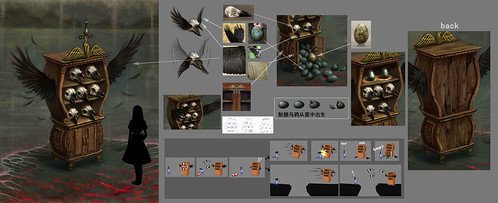
Ugly NPCs

Ugly NPCs

Here’s something I wrote a while back when trying to convince the team that our online racing game should allow for ugly characters. Does it convince you?

Online games dependent on micro-transactions and purchase of items must create and maintain a compelling library of buyable content. Generally this content is geared towards improving player’s abilities in-game, either upgrading performance of a vehicle, allowing access to a bigger weapon, or resupplying ammo/fuel for those weapons and vehicles. Purchases can also be purely cosmetic – improving Player’s outfit, hair style, or physique.

Play imbalance is created when Players with money are able to purchase upgrades that improve their in-game ability. This influences their win/lose ratio, making it possible for inferior Player to defeat superior Players, simply because they spent money. In a system like this it is impossible to maintain a culture of fairness. Every defeat is “unfair” because the opponent likely used a purchased upgrade to attain it. Every win is “hollow” because no real skill was used in attaining it.

It is agreed that in a fair and balanced PvP environment purchased items should not upgrade or influence a Player’s ability to win. This means purchased items are purely cosmetic.

Purely cosmetic upgrades create a problem, specifically “Why would anyone purchase them?”

This question goes to the root of all purchases, virtual or real.
Purchased items fall into two categories: “Necessities for Survival” (needs) or “Items of Desire” (wants).
Necessities for Survival include food, clothing, shelter, medicine.
Items of desire include jewelry, designer clothes, and general “luxury” objects.
Necessities are things every person needs to survive. Items of desire only matter in context of a social group.

Marketing tells us we need objects in order to be better people, feel better about ourselves, and impress our peers. If not for marketing, every person in the world might exist on the same basic set of durable goods. Marketing tells us we aren’t enough, that more is needed to be “complete”. As such, purchasing is ultimately driven by fear.

In-game the ability to visually register the material worth of a character is limited. How can I know the worth of your shoes upon immediate inspection?

Solution: Our brains have evolved to be powerful facial characteristic readers. We are walking face “value scanners”. A game geared towards the creation and maintenance of facial “value” taps into this most basic skill of the human brain.
Facial beauty is a function of ratios and relational harmonies. A character creation system with built-in flaws limits Player to creating only ugly faces.
Real-world marketing tells us their products will make us more beautiful, more handsome – but without radical and expensive surgery these promises are unattainable. In a virtual environment, the promise can be a reality.

Typical facial creation systems assume Player will build a face at the start of the game and then leave it until the end. By linking the facial manipulation mechanic into the store we create a constant driver to spend time/money on making a player character more and more attractive. The promise of all those marketing campaigns becomes a reality.

Races (crashes specifically) will deliver damage to Player Character’s face, clothing and body.

This way we create an instantly recognizable value system within the game which can be monetized through make-up, insurance, surgery and more.

Image reference for ugly characters taken from this Game Informer article.

China on a Budget

I’m always amazed when I hear of friends spending $350USD or more per day for hotels in Shanghai. Sure, they’re nice… but if you’re hardly in them, what’s the point. So I’m glad to read the WSJ has an article highlighting the many fine and cheap hotel options available across China. From the article:

What can a $35 Chinese hotel room offer that some $350 rooms lack? Plenty, if you’re staying in a budget hotel.

With free in-room Internet access, many waist-level electrical outlets for easy recharging, and often new plumbing and excellent lighting, these hotels have mushroomed over the past few years, sometimes by the hundreds in major Chinese cities. One chain, Green Tree Inns, says it has 63 budget hotels in Shanghai alone. Yet most foreigners don’t know about them. Alex Xu, Green Tree’s chief executive, estimates that foreign clients make up only 5% to 10% of his patrons, who are largely Chinese business travelers.

American investors are more clued in. Morgan Stanley owns a chunk of the Motel 168 chain and its slightly upscale sister, Motel 268, through one of its real-estate investment funds. Green Tree’s Mr. Xu is a naturalized American citizen who owns the company along with several other California business partners. The concern had 200 hotels last year, added 200 more this year, and is planning another 300 in 2010.

It’s unlikely these budget hotels will remain undiscovered for long, as more visitors book their own travel to China, rather than relying on group tours or travel agencies. Last year, only 54% of foreigners visiting China went through travel agencies or tour operators, and often only for hotel and airline bookings, not group tours, says Xu Jing, regional representative for Asia and the Pacific at the World Tourism Organization, a United Nations agency.

Read the full article at Wall Street Journal Online.